

 Jilibet Guides
 Slots
Slots Fishing
 Live Casino
 Sports Betting
 Lottery
 Blog
Blog Promotions
How to play 3-card poker is a common question for beginners entering the world of online casino games, as this fast-paced format is both simple and exciting. With only three cards, players can quickly understand the basics and make smart decisions each round. In this guide, Jilibet will walk you through the rules, betting options, and essential strategies to help you start playing with confidence.
What Makes 3-Card Poker Unique and Worth Playing
Unlike traditional poker formats that require multiple players and complex strategies, 3-card poker focuses on speed and simplicity while still delivering strong winning potential. Each round is designed to be quick, allowing players to stay engaged without needing deep poker knowledge or long decision-making time.
Another key appeal lies in its flexible betting system, where players can choose between standard gameplay and optional side bets for higher rewards. This combination of low entry difficulty and exciting payout opportunities makes the game especially attractive for beginners looking to explore casino table games with confidence.
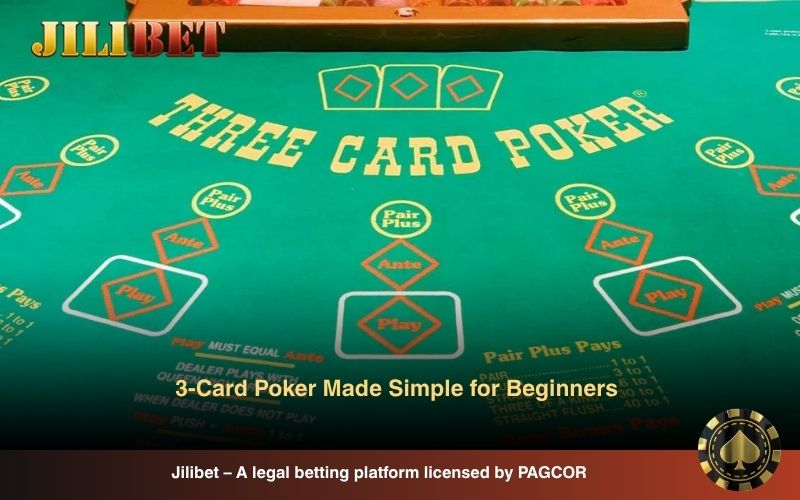
How to Play 3-Card Poker Step by Step
Understanding how to play 3-card poker step by step is essential if you want to make confident decisions and avoid unnecessary losses in each round.

Place your Ante bet
Every round begins with an Ante bet, which is the mandatory wager required to receive your cards. This bet determines your participation in the game and sets the base for your potential winnings if you decide to continue the round.
Receive three cards
After placing your Ante, both you and the dealer are dealt three cards face down. At this stage, as you learn how to play 3-card poker, you can evaluate your hand strength and start planning whether it’s worth continuing or folding.
Decide to fold or play
Once you see your cards, you must choose between folding or placing a Play bet equal to your Ante. Folding means you lose your Ante, while playing gives you a chance to compete directly against the dealer.
Dealer qualification rules
For the round to proceed normally, the dealer must have at least a Queen-high hand. When learning how to play 3-card poker, it’s important to understand that if the dealer does not qualify, you automatically win the Ante, and your Play bet is returned without further comparison.
Compare hands and payouts
If the dealer qualifies, both hands are revealed and compared. If your hand ranks higher, you win both Ante and Play bets with standard payouts, making hand strength evaluation crucial to long-term success.
Understanding Betting Options in 3-Card Poker
Knowing which bets to place is a key part of understanding how to play 3-card poker effectively, especially if you want to balance risk and maximize your potential returns.

Ante and Play explained
The Ante and Play combination is the core betting structure of 3-card poker. The Ante starts the round, while the Play bet allows you to continue after seeing your cards. Winning against the dealer typically pays even money, making this the most stable betting option.
Pair Plus side bet
Pair Plus is an optional side bet that pays based solely on the strength of your three-card hand, regardless of the dealer’s cards. As you learn how to play 3-card poker, you’ll notice that while it offers higher payouts for strong hands, it also comes with greater variance, making it more suitable for players seeking bigger wins.
Optional bonus bets
Some tables include additional bonus bets that reward specific hand combinations or special outcomes. These bets can significantly boost payouts but should be used carefully, as they often carry higher house edges compared to standard gameplay.
3-Card Poker Hand Rankings Explained
Understanding hand rankings is a crucial part of learning how to play 3-card poker, as it directly determines your chances of winning against the dealer. Compared to traditional poker, the ranking system is slightly different, so recognizing these variations will help you make better decisions in every round.

Another important detail when mastering how to play 3-card poker is knowing which hands carry the most value. Even small differences in ranking can significantly impact your results, especially in fast-paced gameplay where quick evaluation is essential.
| Hand | Strength Level | Notes |
| Straight Flush | Strongest | Three consecutive cards of same suit |
| Three of a Kind | Very Strong | Higher than straight in this game |
| Straight | Strong | Ranks higher than Flush |
| Flush | Medium | Same suit, not consecutive |
| Pair | Low | Two cards of same rank |
| High Card | Weakest | No combination |
Payout Table and Winning Potential
To fully understand how to play 3-card poker effectively, it’s important to know how payouts work across different betting options. Each type of bet offers a different reward structure, and understanding these differences helps you manage expectations and avoid unnecessary risks.

When exploring how to play 3-card poker, players should also consider that higher payouts usually come with higher variance. While side bets can deliver big wins, the standard Ante and Play bets often provide more consistent results over time.
Pair Plus Payout (Typical)
| Hand | Payout |
| Straight Flush | 40:1 |
| Three of a Kind | 30:1 |
| Straight | 6:1 |
| Flush | 3:1 |
| Pair | 1:1 |
Ante Bonus (Typical)
| Hand | Bonus Payout |
| Straight Flush | 5:1 |
| Three of a Kind | 4:1 |
| Straight | 1:1 |
Basic Strategy to Improve Your Chances
To improve long-term results, players need more than just understanding the rules—they must also apply a clear strategy. When learning how to play 3-card poker, knowing when to play or fold can significantly reduce losses and increase consistency.
- Follow the Q-6-4 rule: Always play if your hand is Q-6-4 or higher. This is the most widely accepted baseline strategy when learning how to play 3-card poker efficiently.
- Play strong hands confidently: Any hand with Ace, King, or a Pair should always be played, as these combinations offer a higher probability of beating the dealer.
- Fold weak hands early: Hands lower than Q-6-4 should generally be folded to minimize unnecessary losses and protect your bankroll.
- Avoid over-relying on side bets: While tempting, side bets like Pair Plus come with higher variance and should not replace a solid core strategy.

Practical Tips for Beginners
Applying practical habits can make a noticeable difference, especially for new players trying to gain confidence in fast-paced gameplay.
- Start with Ante and Play bets only: Focus on the core game before exploring additional betting options to build a stable foundation.
- Keep your betting consistent: Avoid sudden changes in bet size, as consistency helps you better track results and manage risk.
- Set a bankroll limit before playing: Decide how much you’re willing to spend and stick to it to avoid emotional decisions.
- Choose reliable platforms: Playing on trusted sites ensures fair gameplay and secure transactions.

Common Mistakes to Avoid
Even simple games can lead to consistent losses if common mistakes are not recognized early. Understanding these pitfalls is part of mastering how to play 3-card poker effectively.
- Playing every hand without strategy: Not every hand is worth playing, and ignoring this can quickly drain your balance.
- Misunderstanding dealer qualification rules: Failing to recognize when the dealer qualifies may lead to incorrect expectations about payouts.
- Chasing high payouts from side bets: Focusing too much on big wins instead of consistent strategy often increases losses.
- Ignoring bankroll management: Without proper limits, even a good strategy can fail due to poor financial control.

FAQs About How to Play 3-Card Poker
Here are some of the most common questions players have when getting started with this fast-paced card game.
Is 3-card poker skill or luck?
It is a mix of both, but understanding how to play 3-card poker strategically can reduce randomness and improve your overall results.
What is the best strategy?
The most effective approach is following the Q-6-4 rule and avoiding unnecessary risks with weak hands.
Can you beat the house edge?
While you cannot eliminate it completely, using proper strategy can significantly minimize the house advantage.
Is Pair Plus worth it?
It can be fun for higher payouts, but it carries more risk compared to standard Ante and Play bets.
Conclusion
How to play 3-card poker is easier to understand than many other casino games, but applying the right strategy is what truly makes a difference in your results. By focusing on smart decision-making, proper bankroll management, and avoiding common mistakes, players can enjoy a more consistent experience. At Jilibet, you can explore this exciting game in a secure and user-friendly environment while improving your skills over time.