

 Jilibet Guides
 Slots
Slots Fishing
 Live Casino
 Sports Betting
 Lottery
 Blog
Blog Promotions
How to play Mau Binh is a common question for players who want to master this strategic card game where arranging your hand correctly is the key to winning. Unlike many traditional games, Mau Binh focuses on how you divide and organize your cards into three hands. In this guide, Jilibet will break down the rules, hand setup, and smart strategies to help you play more effectively and avoid costly mistakes.
Why Mau Binh Is a Game of Skill and Decision-Making
What makes Mau Binh different from many other card games is the emphasis on planning before the action begins. Instead of reacting to each turn, players must carefully evaluate their entire hand and decide how to split it into three balanced sections, which requires both logic and foresight.
Another key appeal lies in the variety of possible arrangements, where even the same set of cards can lead to different outcomes depending on how they are organized. As you continue learning how to play Mau Binh, you will realize that smart hand arrangement often matters more than simply having strong cards.

How to Play Mau Binh Step by Step
Understanding how to play Mau Binh becomes much easier when you follow the correct sequence of actions in each round. The game focuses on arranging your cards into three hands and comparing them with opponents to determine the winner.

Deal 13 cards to each player
Each player is dealt 13 cards from a standard 52-card deck. This is the foundation of the game, as all strategies depend on how you manage and arrange these cards.
Arrange cards into 3 hands
Players must divide their 13 cards into three hands: two hands of 5 cards and one hand of 3 cards. Learning how to play Mau Binh effectively means knowing how to balance these three hands for the best overall strength.
Rules for valid hand order
The order of the three hands is critical. The first hand must be the strongest, the second hand must be weaker, and the last hand must be the weakest. If you break this rule, it results in binh lủng (invalid arrangement) and you automatically lose.
Compare hands with opponents
After all players finish arranging their cards, each hand is compared with the corresponding hand of opponents. Winning more hands gives you an advantage in the final result.
Calculate results
The outcome is based on how many hands you win or lose. Some variations include bonus points for special hands, but in general, consistency across all three hands determines your success.
How to Arrange 3 Hands Correctly
To master how to play Mau Binh, arranging your three hands correctly is the most important skill. Even with strong cards, poor arrangement can lead to immediate loss, while smart structuring can turn average hands into winning ones.
|
Hand |
Cards |
Rule |
|
First hand (Front) |
5 cards |
Must be the strongest hand |
|
Second hand (Middle) |
5 cards |
Must be weaker than the first but stronger than the last |
|
Third hand (Back) |
3 cards |
Must be the weakest hand |
Notes:
- Always maintain the correct order: Front > Middle > Back
- Avoid placing strong combinations in the wrong position
- Breaking this order leads to binh lủng, resulting in an automatic loss

Hand Rankings in Mau Binh Explained
To fully understand how to play Mau Binh, players must be familiar with the hand ranking system, which follows the same structure as traditional poker. Knowing the strength of each hand allows you to arrange your cards correctly and avoid costly mistakes when comparing with opponents.
Another key point when learning how to play Mau Binh is recognizing how each ranking impacts your three hands. Even a small difference in hand strength can determine whether you win or lose in each comparison.
|
Rank |
Hand | Notes |
|
1 |
Straight Flush |
Strongest hand, same suit in sequence |
|
2 |
Four of a Kind |
Four cards of the same rank |
|
3 |
Full House |
Three of a kind + a pair |
|
4 |
Flush |
Five cards of the same suit |
|
5 |
Straight |
Five consecutive cards |
|
6 |
Three of a Kind |
Three cards of the same rank |
|
7 |
Two Pair |
Two different pairs |
|
8 |
One Pair |
One pair of cards |
| 9 | High Card |
No valid combination |
Special Hands and Bonus Wins
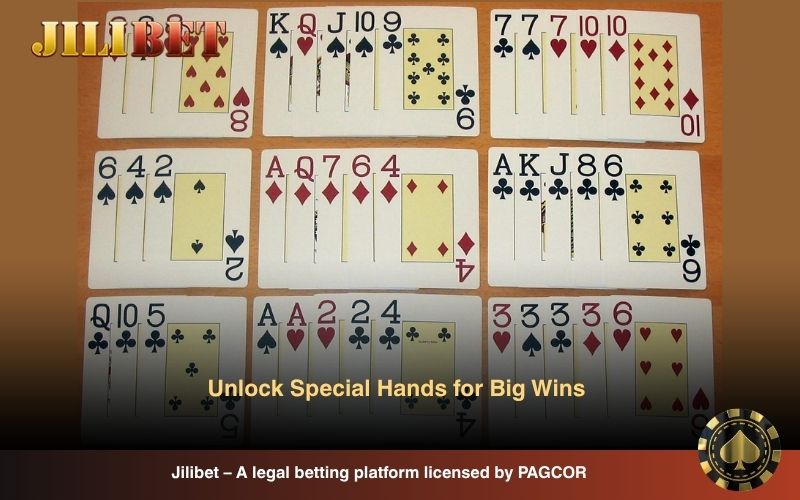
When learning how to play Mau Binh, special hands can give players a significant advantage or even lead to instant wins. These rare combinations often provide bonus rewards and can completely change the outcome of a game.
Understanding how to play Mau Binh also means recognizing these special hands quickly, as they allow you to maximize your winning potential without needing to compare each hand individually.
|
Special Hand |
Meaning |
Advantage |
|
Dragon (13-card straight) |
All 13 cards form a consecutive sequence |
Instant win |
|
Six Pairs |
Six different pairs in one hand |
Strong bonus hand |
|
Three Straights |
Three separate straights across all hands |
High scoring potential |
|
Three Flushes |
All three hands are flushes |
Bonus advantage |
Winning Rules and Scoring System
To fully understand how to play Mau Binh, players need to know how results are calculated after arranging their hands. The game is decided by comparing each hand with opponents and counting the number of wins and losses.
|
Element |
Explanation |
|
Hand comparison |
Each player compares all 3 hands with opponents’ corresponding hands |
|
Winning a hand |
If your hand is stronger, you win that round |
|
Losing a hand |
If your hand is weaker, you lose that round |
|
Total result |
The final outcome depends on how many hands you win or lose |
| Bonus scoring |
Special hands may give extra points or instant wins |
Notes:
- You compare Front vs Front, Middle vs Middle, Back vs Back
- Winning more hands leads to overall victory
- Consistency across all 3 hands is key to success
Basic Strategy to Improve Your Chances
To get better at how to play Mau Binh, players must focus on balancing their hands instead of relying on luck. A strong strategy helps you avoid mistakes and increases your chances of winning across all three hands.
- Balance all 3 hands: Distribute your cards evenly instead of making one hand too strong and others too weak.
- Don’t over-stack one hand: Putting all strong cards into a single hand can cause you to lose the remaining comparisons.
- Avoid invalid order (binh lủng): Always ensure the correct strength order to prevent automatic loss.
- Plan before arranging: Take time to evaluate your cards and choose the best structure before finalizing.

Practical Tips for Beginners
New players learning how to play Mau Binh can improve faster by applying simple techniques that reduce mistakes and build confidence.
- Start with simple arrangements: Focus on basic hand structures before trying complex setups.
- Learn ranking first: Understanding hand strength is essential for arranging cards correctly.
- Avoid risky setups: Do not take unnecessary risks that may lead to imbalance or invalid hands.
- Practice pattern recognition: The more you play, the easier it becomes to identify strong arrangements quickly.
Common Mistakes to Avoid (Binh Lung)
When learning how to play Mau Binh, avoiding common mistakes is just as important as understanding the rules. Many players lose not because of weak cards, but because of poor arrangement decisions that lead to serious errors.
- Wrong hand order: Placing weaker hands above stronger ones breaks the core rule and results in binh lủng, meaning you automatically lose the entire game.
- Overloading strong cards: Putting too many strong cards into one hand weakens the remaining hands, increasing the chance of losing overall.
- Ignoring balance between hands: Focusing only on one or two hands instead of all three reduces your chances of winning multiple comparisons.
- Misreading hand strength: Incorrectly evaluating your cards can lead to poor arrangement and missed opportunities.
Notes:
- Binh lủng = automatic loss, regardless of how strong your cards are
- Always double-check your hand order before finalizing

FAQs About How to Play Mau Binh
Here are some common questions players often have when getting started with this strategic card game.
Can you rearrange your cards after setting them?
No, once you finalize your arrangement, it cannot be changed. This is why careful planning is essential before locking in your hands.
Is it better to focus on one strong hand or balance all three?
Balancing all three hands is usually more effective, as winning multiple comparisons gives you a higher overall advantage.
What happens if two players have equal hands?
If both hands are equal in strength, the result is usually considered a tie, and no points are awarded for that comparison.
Are special hands common in Mau Binh?
Special hands are relatively rare, which is why they often come with higher rewards and can instantly change the outcome of a game.
How much time do players have to arrange their cards?
In most versions, players are given a limited time to arrange their cards, so quick thinking and experience play an important role.
Conclusion
How to play Mau Binh may seem simple at first, but mastering the game requires careful planning, proper hand arrangement, and a solid understanding of the rules. By avoiding mistakes like binh lủng and applying smart strategies, players can improve their chances of winning consistently. At Jilibet, you can enjoy a smooth and engaging experience while practicing your skills and becoming more confident in every game.